

I’ve spent years figuring out how to travel without the usual headaches that make people dread airports and packing lists.
You want your trips to feel like adventures, not survival missions. But somewhere between booking the flight and actually landing, travel turns into a mess of forgotten chargers, overweight bags, and blown budgets.
I get it because I’ve been there too many times.
This article pulls together the best travel hacks from the Conversations with Bianca series. These aren’t tips I found on some generic blog. They’re what actually works when you’re standing in a cramped hostel room or racing through a connection in Frankfurt.
I’ve tested these strategies across dozens of countries and countless trips. The ones that made it here? They saved me money, time, or sanity (sometimes all three).
CwBiancaVoyage exists because travel should open you up to the world, not stress you out before you even leave home.
You’ll learn how to pack smarter without sacrificing what you need. How to move through airports like you know what you’re doing. And how to stretch your budget further without sleeping on park benches.
These are real solutions for real travel problems.
No fluff about finding yourself or becoming a citizen of the world. Just practical advice that makes your next trip better than your last one.
The Pre-Voyage Blueprint: Smart Booking & Planning Hacks
Everyone tells you to book early.
But that’s only half the story.
I’ve watched travelers overpay for trips they booked months in advance because they missed one simple thing. Timing matters more than how far ahead you book.
The Shoulder Season Secret
Here’s what most travel sites won’t tell you. The week right after peak season ends? That’s when you get the best deal. Hotels drop prices by 40% and suddenly those crowded attractions are walkable again.
I’m talking about visiting Greece in late September instead of August. Or hitting Southeast Asia in November before the Christmas rush.
The weather’s still good (sometimes better without the humidity). You just skip the crowds and the inflated prices.
Now some people say shoulder season means risking bad weather or closed attractions. Fair point. But I’ve found that risk is overblown. Most places operate year-round now. You might miss one festival but you’ll actually see the destination instead of fighting through tour groups.
Finding Prices Others Miss
Google Flights has a price tracker that most people ignore. Set it up for flexible dates and watch what happens. Prices can swing $200 in a single day.
Here’s something I learned from backpacking tips cwbiancavoyage from conversationswithbianca. Some booking sites show different prices based on your location. A VPN lets you check what travelers in other countries see. I’ve saved $150 on hotels just by switching my virtual location.
Does it always work? No. But when it does, you’re getting the same room for less money.
I also keep everything in a digital travel wallet. Cloud folder with passport scans, visa copies, every booking confirmation. My phone died in Morocco once and I still had everything on my tablet. That folder saved me hours at the embassy.
Pro tip: Email these files to yourself too. Double backup never hurts.
The Hub and Spoke Approach
Most people pack up and move hotels every two days. It’s exhausting.
I use what by conversationswithbianca traveling hacks cwbiancavoyage calls the hub and spoke model. Pick one base and take day trips. You unpack once, learn where the good coffee is, and stop wasting half your vacation in transit.
Stay in Florence for a week. Day trip to Siena, Pisa, San Gimignano. Come back to the same bed every night.
Your energy stays high and you’re not dragging luggage across cobblestones every morning.
Mastering Your Luggage: The Art of Packing Light & Right
I used to be that person at the airport.
You know the one. Struggling with an overstuffed suitcase, paying baggage fees, and still forgetting half the things I actually needed.
Then I figured something out. Packing isn’t about fitting more stuff in. It’s about bringing less of the right stuff.
Some travelers will tell you to just pack whatever makes you comfortable. They say you can’t put a price on peace of mind, so bring that extra pair of jeans and the fourth sweater just in case.
I get where they’re coming from. But here’s what they don’t tell you.
Every extra item you pack is something you have to carry, wash, and keep track of. That “just in case” mentality turns into a 50-pound anchor.
The Packing Cube Philosophy
Most people think packing cubes are just fancy bags. They’re not.
I use them to create a modular system. One cube for tops, one for bottoms, one for undergarments. But here’s the trick: I also pack by activity when it makes sense.
Beach day? Everything’s in one cube. City exploring? Another cube. (This way I’m not digging through my entire suitcase every morning.)
The compression aspect matters too. You can actually fit more by organizing better, which sounds backwards until you try it.
The 3-Shoe Rule
Here’s where I lose people.
Three pairs of shoes. That’s it.
One for walking. These are your workhorses. Comfortable sneakers or walking shoes that can handle 20,000 steps.
One for dressing up. Doesn’t have to be fancy, just presentable enough for a nice dinner or business meeting.
One specialty pair. Sandals for beach trips, boots for hiking, whatever your destination demands.
I’ve traveled to 30+ countries with this system through cwbiancavoyage, and I’ve never wished I brought more shoes. Not once.
The Solid Toiletry Revolution
Liquid toiletries are a scam for travelers.
I switched to solid shampoo bars, conditioner bars, and toothpaste tabs two years ago. Never looked back.
No TSA hassles. No exploded shampoo bottles in your bag. (If you’ve experienced that nightmare, you know.)
Plus they last longer than you’d think. One shampoo bar gets me through a month-long trip easily.
The Unsung Hero: The Sarong
This is my secret weapon.
A lightweight sarong or large scarf does more work than any other single item in my bag. I’ve used mine as a beach towel, airplane blanket, modest cover-up for temples, picnic blanket, and even a makeshift privacy curtain in sketchy hostels.
It weighs almost nothing and takes up barely any space.
Most packing lists skip this completely, which is wild to me. It’s probably the most useful thing I own.
Tech Kit Essentials
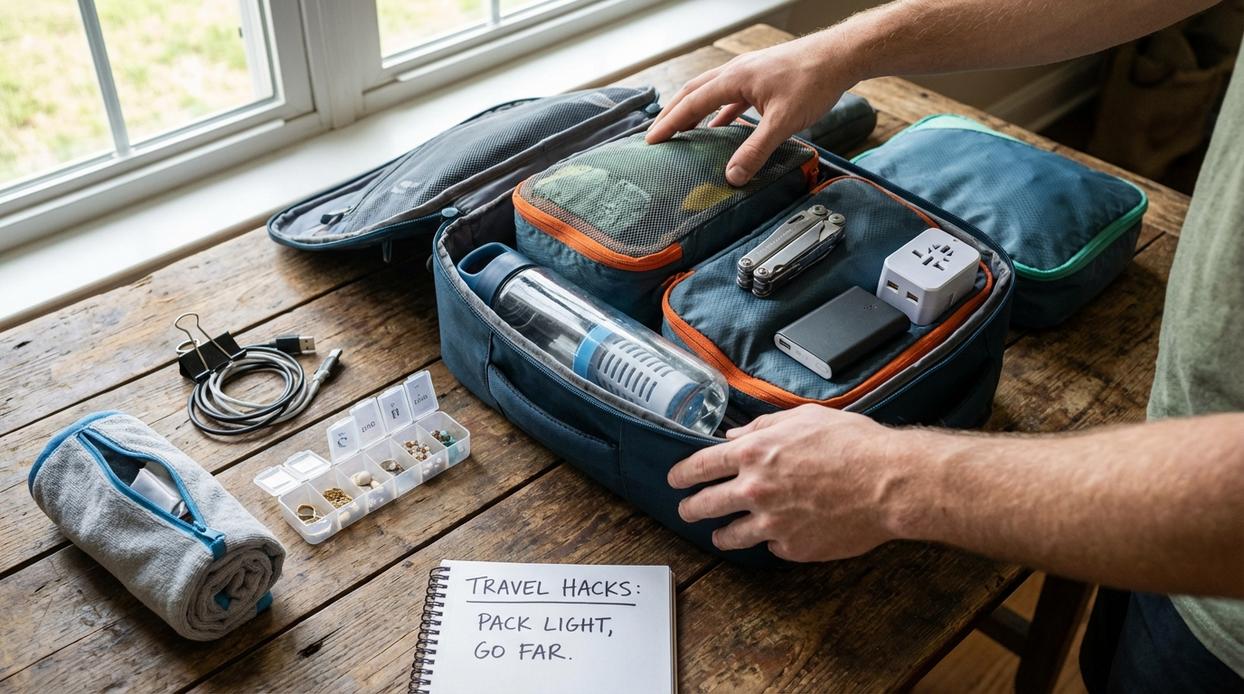
I keep all my tech in one small pouch.
Universal adapter. Slim power bank. Extra charging cables for my phone and laptop. That’s the core.
Here’s what I learned the hard way: buy quality cables. Cheap ones die at the worst possible moments, usually when you’re in a country where replacements cost three times what they should.
Pro tip: Take a photo of your tech kit laid out before you leave. Makes it easy to spot if you’ve left something behind at a hotel.
The whole kit fits in a space smaller than a paperback book. No anxiety about dead devices or incompatible plugs.
Look, packing light isn’t about deprivation. It’s about freedom. Freedom to move quickly, skip baggage claim, and not spend your vacation doing laundry every other day.
You don’t need as much as you think you do.
Airport & Transit Mastery: Navigating Like a Pro
I learned this the hard way back in 2017 at Heathrow.
I was stuck behind someone fumbling with their laptop while a line of 50 people glared at both of us. That’s when I realized something. The security line isn’t where you prepare for security.
You do that before you even get to the bins.
Now I set myself up about 20 feet back. Laptop comes out of my bag. Liquids go in an easy-grab pocket. And I only wear slip-on shoes when I fly (learned that one after hopping around on one foot trying to untie my laces).
It sounds simple but it saves you five minutes every single time.
Here’s what actually matters once you land.
You need internet right away. Not in an hour after you find a cafe. Right when you step off the plane.
I’ve tested three options over the past two years. Local SIM cards are cheap but you have to find a store and deal with activation. Pocket Wi-Fi works great if you’re traveling with others and can split the cost. But eSIMs like Airalo? They changed everything for me.
You download the app before you leave home. Buy your data plan. And the second your plane touches down, you’re connected.
No hunting for a SIM card vendor at 11 PM in a foreign airport.
Speaking of being prepared, I keep what I call a go bag inside my carry-on. It’s just a small pouch with everything I need during the flight. Headphones, lip balm, hand sanitizer, a pen for customs forms, and snacks.
(Because airplane snacks are either nonexistent or cost $12 for a sad sandwich.)
The trick is keeping it accessible. Top pocket of your bag. Not buried under three layers of clothes.
One more thing that’ll save you hours of confusion.
Download your transit apps before you leave. I’m talking about Citymapper and whatever metro app the city uses. Do it while you’re still at home with good Wi-Fi.
I made the mistake of trying to figure out the Tokyo metro system while standing in Narita Airport with no data. It was not fun.
Now I spend ten minutes before any trip downloading the apps I’ll need. It’s one of those conversationswithbianca traveling hacks cwbiancavoyage that seems obvious until you’re standing in a train station with no idea which line to take.
Your phone becomes your best travel tool when you set it up right.
On-the-Ground Smarts: Cultural Immersion & Budgeting
You know what most travelers get wrong?
They ask locals for the “best” restaurant. Then they end up at some overpriced tourist trap that got mentioned in a guidebook once.
Here’s what actually works.
Ask where they go with their family for a great meal. I started doing this in Barcelona and ended up at a tiny tapas place where the owner’s grandmother was still cooking. No English menu. Just real food that locals actually eat.
The question you ask changes everything.
Now let’s talk money because this is where people lose hundreds without realizing it.
You need a travel credit card with no foreign transaction fees. Period. Chase Sapphire and Capital One Venture both waive these fees (and I’ve tested both across 20+ countries). That 3% foreign transaction fee adds up fast when you’re spending $2,000 on a trip.
Get a debit card that reimburses ATM fees too. Charles Schwab does this with no monthly minimums. I’ve pulled cash from sketchy ATMs in rural Thailand and got every fee refunded.
Here’s something nobody tells you.
Schedule a day with no plans. I know it sounds counterproductive when you’ve paid good money to be somewhere. But some of my best travel memories happened on these free days.
In Lisbon, I wandered into a neighborhood festival I didn’t know existed. In Tokyo, I found a vinyl record shop run by a 70-year-old jazz collector. None of that was on my itinerary.
Travel burnout is real. A study from the Journal of Travel Research found that over-scheduled trips actually decrease satisfaction and increase stress levels.
One more thing that matters more than you’d think.
Learn hello, please, and thank you in the local language. Takes you five minutes before your flight. But when you greet someone in Greek or Vietnamese, their whole face changes. You’re not just another tourist asking for directions in English.
I’ve gotten free desserts, insider tips, and genuine conversations just by trying. Even when I butcher the pronunciation (which happens a lot).
These conversationswithbianca traveling hacks cwbiancavoyage aren’t complicated. But they work because they’re based on how real travel actually happens, not how guidebooks say it should.
I pack light because I’ve learned the hard way that heavy bags kill your travel vibe.
You came here looking for real ways to make your trips smoother. The kind of tips that actually work when you’re standing in an airport at 5am or trying to navigate a new city.
I’ve put together the strategies that changed how I travel. These aren’t theory. They’re what I use every time I leave home.
Poor planning creates stress. Overpacking slows you down. Travel-day chaos steals the excitement you should be feeling.
These conversationswithbianca traveling hacks solve those problems.
Being prepared means you get to focus on what matters. The new food you’re trying. The streets you’re exploring. The people you’re meeting.
When you’re intentional about the logistics, the discovery part takes care of itself.
Your Next Trip Starts Now
You have what you need to plan differently this time.
Take these cwbiancavoyage strategies and map out your next adventure. Start with your packing list. Then tackle your day-one itinerary.
The difference between a stressful trip and a smooth one often comes down to what you do before you leave. You can control that part.
Your smoothest-ever adventure is waiting. Time to make it happen. Homepage. Advice Cwbiancavoyage.
 Founder & Visionary Director
Syrelia Xelthorne is the visionary founder of the organization, known for her bold ideas and relentless determination. She established the company with a mission to blend innovation, culture, and global connectivity. With a background in international development and creative strategy, she shaped the company’s long-term vision. Her leadership style combines empathy with decisive action, earning her deep respect across teams. Syrelia is passionate about building inclusive opportunities and empowering emerging talent. She remains actively involved in strategic partnerships and global expansion efforts. Under her guidance, the organization has grown into a recognized leader in its field.
Founder & Visionary Director
Syrelia Xelthorne is the visionary founder of the organization, known for her bold ideas and relentless determination. She established the company with a mission to blend innovation, culture, and global connectivity. With a background in international development and creative strategy, she shaped the company’s long-term vision. Her leadership style combines empathy with decisive action, earning her deep respect across teams. Syrelia is passionate about building inclusive opportunities and empowering emerging talent. She remains actively involved in strategic partnerships and global expansion efforts. Under her guidance, the organization has grown into a recognized leader in its field.